
ADHD is a neurodevelopmental condition affecting attention, impulse control and activity levels. In children it usually shows up as difficulty sustaining focus, acting before thinking, or constant restlessness – present before age 12, lasting at least six months, and appearing in more than one setting. If the difficulty happens only at school or only at home, it is usually something else.
Most parents do not arrive at this question on their own. They arrive because a teacher said something. Your child talks over the class. Does not finish work. Loses everything. Cannot sit. And then the word gets used, often by someone with no training to use it, and you go home and start searching.
This guide will not tell you whether your child has ADHD – nothing you read online can. What it can do is help you tell the difference between ordinary childhood energy and a pattern worth having looked at properly.
What ADHD actually is
ADHD stands for Attention Deficit Hyperactivity Disorder. It is a difference in how the brain manages attention, impulses and activity – not a behaviour problem, not a parenting failure, and not something a child chooses.
It appears in three presentations, and the second one is the most often missed:
- Predominantly inattentive – drifts, forgets, loses things, cannot finish. Often quiet. Frequently mistaken for laziness or daydreaming.
- Predominantly hyperactive-impulsive – restless, interrupts, cannot wait, acts before thinking. This is the version everyone pictures.
- Combined – features of both, and the most common presentation.
A child with the inattentive presentation causes no trouble in class, so nobody raises it. This is a large part of why girls are identified later than boys, and sometimes not until secondary school.
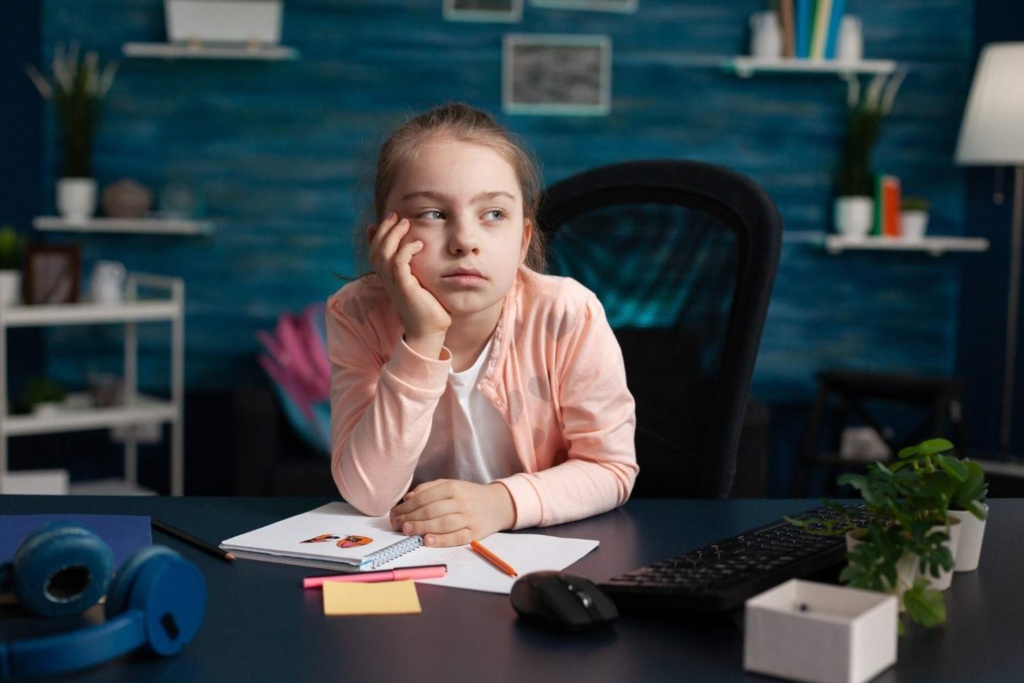
Signs of ADHD in children
These are patterns, not a checklist to score. Every child does some of these sometimes. What matters is how often, how much it interferes, and whether it happens everywhere.
Signs of inattention
- Cannot hold attention on schoolwork, but can focus for hours on something they enjoy
- Appears not to listen when spoken to directly
- Starts tasks and abandons them unfinished
- Loses school items constantly – pencils, books, water bottle, homework
- Avoids anything requiring sustained mental effort
- Makes careless mistakes, especially on work they clearly understand
- Forgets instructions given moments earlier
Signs of hyperactivity and impulsivity
- Fidgets, squirms, cannot stay seated when expected to
- Runs or climbs at inappropriate times – or in older children, a constant inner restlessness
- Talks excessively, blurts out answers before the question is finished
- Cannot wait for a turn
- Interrupts conversations and games
- Acts first and understands the consequence afterwards
The three conditions that separate ADHD from ordinary childhood
This is the part most online checklists leave out, and it is the part that matters most. For ADHD to be considered, all three of these must hold:
Condition | What it means |
Present before age 12 | The pattern is long-standing, not something that started this year. A change that began recently usually points elsewhere – a bereavement, a move, bullying, or something at home. |
Present in more than one setting | It shows at school AND at home, or at home AND at tuition. A child who is difficult in only one place is usually reacting to that place. |
Interfering, not just present | It is measurably getting in the way of learning, friendships or family life. Energetic is not the same as impaired. |
If your child is restless at school but fine everywhere else, that is worth investigating – but it is unlikely to be ADHD.
What ADHD is not caused by
There is a great deal of confident misinformation on this, and most of it lands on parents as blame.
- Not caused by sugar. This has been studied repeatedly and the link does not hold up.
- Not caused by bad parenting. Parenting affects how well a child copes; it does not create the condition.
- Not caused by screens. Heavy screen use can worsen attention and is worth limiting, but it does not cause ADHD.
- Not caused by vaccines.
ADHD has a strong genetic component. It is common for a parent to recognise a good deal of their own childhood while reading a list like the one above.
Is my child ADHD, or just naughty?
This is the question almost every parent actually wants answered, so here it is directly.
A naughty child can behave when it matters enough. A child with ADHD often cannot, however much they want to – and they usually do want to. The tell is what happens afterwards: children with ADHD are frequently upset by their own behaviour and genuinely cannot explain it. “I don’t know why I did it” is often the honest answer rather than an excuse.
The second tell is consistency. Deliberate misbehaviour is selective – it appears where a child thinks they can get away with it. ADHD is not selective. It shows up in front of the people the child most wants to impress.
But he can watch a screen for two hours - so it cannot be attention?
This comes up in almost every first conversation, usually from a grandparent, and it deserves a proper answer.
ADHD is not an inability to pay attention. It is difficulty regulating where attention goes. Fast-changing, immediately rewarding activities hold attention easily. Slow, effortful, delayed-reward activities – like a maths worksheet – do not. Intense focus on a game is entirely consistent with ADHD, not evidence against it.
What else can look like ADHD
A good assessment spends as much time ruling things out as ruling ADHD in. Several conditions produce a very similar picture in a classroom:
Looks like ADHD | Might actually be |
Not following instructions | A hearing difficulty, or a receptive language difficulty – the child has not understood, rather than not complied |
Cannot sit still, always moving | A sensory processing difficulty – the child is seeking movement their body is not registering |
Avoids written work, gives up quickly | A specific learning difficulty such as dyslexia, or a fine motor difficulty that makes writing physically tiring |
Distracted, withdrawn, irritable | Anxiety, low mood, or something difficult at home |
Poor sleep and daytime restlessness | A sleep problem, which produces near-identical daytime symptoms |
Social difficulty alongside inattention | Autism, which frequently co-occurs with ADHD |
This is why “he has ADHD” from a teacher, however experienced, is a prompt to get an assessment – not a conclusion.
What an assessment involves
There is no blood test and no scan for ADHD. Assessment is structured information-gathering from several sources.
- A detailed history from you
Pregnancy and birth, developmental milestones, family history, when the difficulties began, and what you have already tried. This is the single most valuable input.
- Information from school
Because the pattern must appear in more than one setting, input from teachers is essential. Standardised rating scales are usually completed by both parents and teachers.
- Direct observation and profiling
Attention, impulse control, motor skills, sensory responses and learning profile, assessed directly rather than inferred.
- Ruling out the alternatives
Hearing, vision, language, learning difficulties, sleep and emotional wellbeing. Skipping this step is how children end up with the wrong label.
- A conversation about what it means
In plain language, with a written plan – whatever the conclusion turns out to be.
A formal ADHD diagnosis is made by a paediatrician, developmental paediatrician, child psychiatrist or clinical psychologist. At Paramount we assess the functional picture – attention, regulation, motor skills, sensory processing, learning – provide the therapy, and work alongside your child’s doctor where a diagnostic opinion is needed. If you do not already have one, we will say so and help you find the right person.
What actually helps
For younger children, international guidance is consistent: behavioural and environmental support comes first, before any consideration of medication.
- Occupational therapy – attention, self-regulation, sensory needs, handwriting, and the practical business of getting through a school day
- Psychological and parent support – structure, routine, and a way of responding that reduces conflict rather than escalating it
- Special education support – for children whose learning has fallen behind, or who have a co-occurring learning difficulty
- School accommodations – seating, shortened tasks, movement breaks, written instructions instead of spoken ones. Often the fastest win available, and free.
- Sleep, routine and exercise – unglamorous, and they make a measurable difference.
Medication exists, it is well studied, and for some children it changes everything. It is also a decision for a doctor, made with you – not something a therapy centre should advise on, and not something to be frightened into or out of by anyone online.
What we would say to a parent reading this at 11pm
Three things.
First: whatever is going on, it is not because you did something wrong. Almost every parent asks this within the first ten minutes, and the answer does not change.
Second: a label is not the point. The point is finding out what is making an ordinary day so hard for your child, and doing something about it. Sometimes the answer is ADHD. Often it is something else entirely. Occasionally the answer is that nothing is wrong.
Third: children with ADHD do well. They are frequently creative, funny, energetic and quick. What they need is the right support early enough, and a household that has stopped assuming they are choosing this.
Symptoms must be present before age 12, and many parents recognise them much earlier. Assessment before school age is harder, because a great deal of what ADHD describes is normal in a three-year-old. Most children are assessed once school begins to demand sustained sitting and independent work.
Hyperactivity often reduces with age. Difficulties with attention, organisation and impulse control frequently continue into adulthood, although many people manage them well using strategies learned early. Early support is largely about building those strategies.
Yes, and it is common. They co-occur frequently, which is one reason an assessment should look at the whole developmental picture rather than testing for one condition in isolation.
Girls more often present with the inattentive type – quiet, dreamy, disorganised, not disruptive. Nobody complains about a child who is not causing trouble, so they are identified later, often after years of being called careless.
In our experience the opposite is true. Without an explanation, a struggling child is usually treated as lazy or badly behaved, which is far more damaging. An assessment gives the school something concrete to work with.
No. Therapy addresses the actual difficulties – attention, regulation, handwriting, sensory needs, learning gaps – not the label. Support frequently begins while assessment is still under way.
Paramount Child Development Centre runs developmental assessment at Durgapura, Jaipur and at Silver Jubilee Road, Sikar. We assess the functional picture, provide occupational therapy, psychological support and special education, and coordinate with your paediatrician where a formal diagnosis is needed.
If this sounded like your child
Book a screening. It is one visit, and it either sets your mind at rest or gives you a plan – both are better than another school year of your child being told they are not trying.
Jaipur: 1st Floor, 10 Tonk Road, opposite BMW Showroom, Durgapura, Jaipur 302015. Monday to Saturday, 10:00 – 19:30.
Sikar: 2nd Floor, Savigo Tower, opposite Police Line, Silver Jubilee Road, Sikar 332001. Monday to Saturday, 9:30 – 18:00.
Call +91 6376 345 510 · WhatsApp us · Book a free screening
This article is for general information and does not replace an individual assessment by a qualified professional. ADHD is diagnosed by a paediatrician, child psychiatrist or clinical psychologist. If you have concerns about your child, please speak to a qualified professional.