
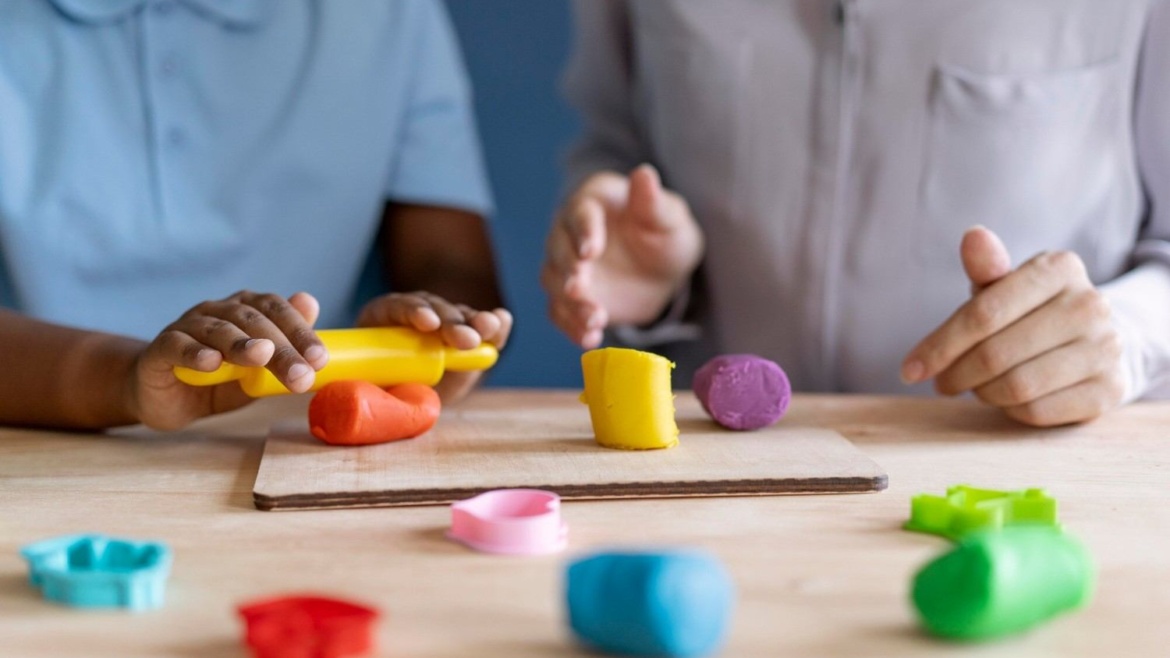
Speech therapy builds communication – understanding language, producing sounds, and being understood. Occupational therapy builds everything a child does with their body and senses – self-care, fine motor skills, attention, and sensory regulation. If your main worry is that your child is not talking, start with speech. If it is that they cannot sit still, hate certain textures, or struggle with buttons and pencils, start with OT. Many children need both.
Most parents arrive at our Durgapura centre having been told two different things by two different people. A relative says speech therapy. A teacher says occupational therapy. Both may be right, and the distinction is less complicated than it sounds.
What speech therapy actually does
Speech-language therapy covers far more than pronunciation. A pediatric speech-language pathologist works on:
- Receptive language – understanding what is said. A child who does not follow “put your shoes near the door” may have a comprehension difficulty, not a defiance problem.
- Expressive language – vocabulary, joining words, forming sentences, telling you what happened at school.
- Articulation – producing sounds clearly enough for people outside the family to understand.
- Fluency – stammering and stuttering.
- Social communication – turn-taking, staying on topic, reading tone. Often the main need for a verbally fluent autistic child.
- Alternative communication – picture systems, signs or devices, so a non-speaking child still has a way to be understood while spoken language develops.
One useful benchmark: by around age three, a stranger should be able to understand roughly three-quarters of what your child says. By four, nearly all of it.
What occupational therapy actually does
“Occupation” confuses parents, because in this context it has nothing to do with jobs. A child’s occupations are the things that fill their day – dressing, eating, playing, writing, sitting through a class. Pediatric OT works on:
• Fine motor skills – pencil grip, scissors, buttons, laces, handwriting that does not hurt after ten minutes.
• Gross motor and coordination – balance, ball skills, climbing, navigating a playground without constant collisions.
• Sensory processing – how a child handles noise, texture, movement and touch, and whether that leaves them overwhelmed or under-stimulated.
• Self-care independence – dressing, feeding, toileting, brushing teeth without a daily battle.
• Attention and self-regulation – the capacity to stay calm and organised enough to learn.
• School readiness – sitting, copying from a board, organising a bag, managing transitions between activities.
A quick sorting guide
Find the line that sounds most like your child. This is a starting point for a conversation, not a diagnosis.
| What you are seeing | Usually starts with | Why |
| Not talking by 18–24 months | Speech therapy | Language production is the primary gap. |
| Talks, but strangers cannot understand | Speech therapy | Articulation and clarity work. |
| Understands nothing you ask | Speech therapy | Receptive language – check hearing too. |
| Stammers or repeats sounds | Speech therapy | Fluency intervention. |
| Cannot hold a pencil, messy handwriting | Occupational therapy | Fine motor and grip strength. |
| Covers ears, hates tags, refuses textures | Occupational therapy | Sensory processing. |
| Cannot sit still, always crashing into things | Occupational therapy | Sensory seeking and regulation. |
| Cannot dress or feed themselves for their age | Occupational therapy | Self-care and motor planning. |
| Extremely fussy eater by texture | Both | OT for the sensory side, speech for oral-motor skills. |
| Autism diagnosis or suspicion | Both | Communication and sensory/motor needs almost always co-occur. |
| Frustrated, melting down, no clear cause | Assessment first | Could be either – an inability to communicate often looks like behaviour. |
Where the two genuinely overlap
Feeding. A child who refuses most foods may have a sensory aversion (OT), weak oral-motor coordination (speech), or both. Feeding therapy is often a joint programme.
Autism. Very few autistic children need only one. Communication, sensory regulation and daily-living skills tend to move together, which is why we run them as one plan rather than two.
Attention. A child who cannot sit is not learning language, however good the speech session is. Sometimes OT has to come first simply so speech therapy can land.
Behaviour. A large share of what gets labelled a behaviour problem is a communication problem wearing a disguise. Give a child a reliable way to say “too loud” or “I want that” and the behaviour often eases on its own.
Do we have to choose?
Not usually. Where a child needs both, the mistake is running them as two unconnected appointments at two clinics, with two sets of goals that never speak to each other.
At Paramount, our occupational therapists and speech-language pathologists sit in the same building and write a single plan. If the OT finds that your child regulates better after ten minutes of heavy movement, the speech session gets scheduled after it, not before.
If you can only start with one right now
This is a real constraint for many families, and it deserves a straight answer rather than a sales one.
- If the child has no functional way to communicate – start with speech. Communication reduces frustration fastest, and frustration is usually what is making everything else harder.
- If the child is so dysregulated they cannot sit for a session – start with OT. Regulation is the foundation that other therapy is built on.
- If school is the pressure point – handwriting, sitting, keeping up – start with OT.
A good assessment will tell you which of these you are in. Ask for that recommendation explicitly, and ask what it is based on.
Frequently asked questions
No, and be cautious of anyone who says otherwise. They are separate qualifications with separate training. An integrated centre gives you both specialists working to one plan – which is not the same as one person doing both jobs.
Small changes often appear within 6–8 weeks; meaningful change usually takes months, not weeks. Any clinic promising a fixed timeline for your child before assessing them is guessing.
The sessions will be calculated at the time of assessment by a qualified professional.
No. Both therapies target specific difficulties, not labels, and can begin while assessment is ongoing.
For OT, usually yes – a properly equipped sensory gym cannot be replicated at home. For speech, the centre provides the structure and the home provides the practice. Both depend heavily on what you do in the other 165 hours of the week.
Still not sure?
That is the normal position to be in, and it is what an assessment is for. Book a developmental screening at our Durgapura, Jaipur or Sikar centre and we will tell you which of the two your child needs – or whether it is neither.
+91 6376 345 510 · WhatsApp us
1 Comment
Comments are closed.