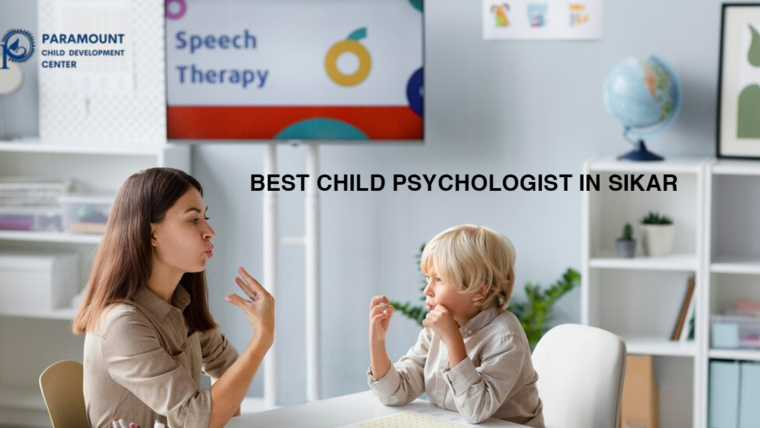
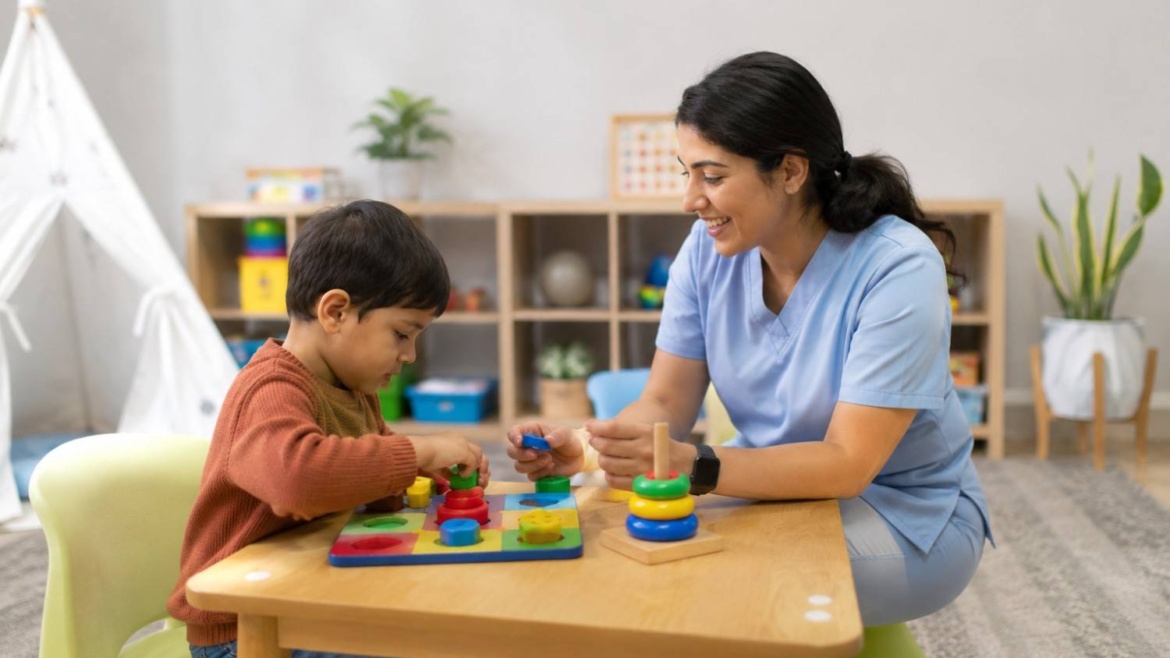
You noticed something. Maybe it was the way your child struggles to hold a pencil, avoids playgrounds, or melts down when their clothes feel “wrong.” Maybe their preschool teacher mentioned they seem a little behind in fine motor skills. Or perhaps you’ve simply had a quiet, nagging feeling that something is different – and you’re not sure what to do next.
First, take a breath. You are not overreacting. You are paying attention. And that attention is the most powerful thing a parent can give a child.
This guide is for you – the parent sitting at 11 PM, searching for answers and hoping someone understands what you’re going through. We’re going to walk you through what pediatric occupational therapy is, what signs might be worth exploring, what you can do at home today, and when it might be time to reach out to a professional at a trusted child development center in Jaipur.
What Is Pediatric Occupational Therapy – And Why Does It Matter?
Many parents hear “occupational therapy” and picture adults recovering from injuries. But for children, occupational therapy (OT) is all about the “occupation” of childhood – playing, learning, dressing, eating, writing, and connecting with others.
A pediatric occupational therapist helps children develop the physical, sensory, cognitive, and social skills they need to participate fully in everyday life. Think of it as building the internal toolkit your child needs to navigate their world with confidence.
At a specialized Occupational Therapy Centre, therapists work on skills like:
- Fine motor skills – using scissors, holding crayons, buttoning clothes
- Gross motor skills – balance, coordination, climbing, jumping
- Sensory processing – how the brain interprets touch, sound, movement, and taste
- Self-care tasks – dressing, feeding, toileting independently
- Visual-motor integration – the ability to coordinate what the eyes see with what the hands do
- Social participation – taking turns, joining group play, managing emotions in social settings
Understanding Developmental Milestones: The “What” Every Parent Should Know
Children develop at their own pace – and that’s completely normal. But there are general windows during which most children reach certain milestones. Knowing these can help you notice when something might be worth a closer look.
Ages 1–3 Years
- Begins stacking blocks (around 12–18 months)
- Uses a spoon with some spilling by age 2
- Starts scribbling and making marks on paper
- Imitates simple actions and play
- Shows interest in other children
Ages 3–5 Years
- Cuts paper with scissors (with some difficulty at first)
- Draws basic shapes like circles and crosses
- Gets dressed with minimal help
- Builds towers of 8+ blocks
- Participates in imaginative play
Ages 5–7 Years
- Writes their name legibly
- Ties shoelaces (with practice)
- Cuts along a curved line with scissors
- Sits still in a classroom for age-appropriate periods
- Manages a fork and knife at mealtimes
These milestones aren’t a strict checklist – they’re guideposts. Missing one or two in isolation is often not a concern. But a pattern of delays across multiple areas might indicate that your child could benefit from a professional evaluation.
Signs Your Child Might Benefit From Pediatric Occupational Therapy in Jaipur
As a parent, your instincts matter. Here are some developmental variations that are worth exploring with a specialist – not to worry you, but to empower you with information.
Sensory Processing Challenges
- Extreme discomfort with certain clothing textures, food textures, or sounds
- Seeks out intense sensory input (spinning, crashing, touching everything)
- Easily overwhelmed in noisy or crowded environments
- Covers ears frequently or avoids eye contact
Fine Motor Difficulties
- Struggles significantly with holding a pencil or crayon
- Avoids activities that require hand use (drawing, puzzles, play-dough)
- Handwriting is very difficult to read for their age
- Difficulty with buttons, zippers, or self-feeding
Coordination and Movement Concerns
- Appears significantly clumsier than other children the same age
- Difficulty learning to ride a bike or pump a swing
- Frequently bumps into furniture or people
- Tires very easily during physical play
Attention and Self-Regulation
- Extreme difficulty transitioning between activities
- Emotional meltdowns that seem disproportionate to the situation
- Very short attention span even for preferred activities
- Difficulty sitting still during meals or structured time
Social Participation
- Avoids group play or seems unsure how to join in
- Gets frustrated very easily when play doesn’t go their way
- Does not engage in pretend or imaginative play by age 3–4
If several of these patterns resonate with what you’re seeing, it may be time to consider a professional screening. If your child has also received – or is being evaluated for – an autism diagnosis, our autism therapy centre in Jaipur offers integrated support alongside occupational therapy for a truly holistic approach.
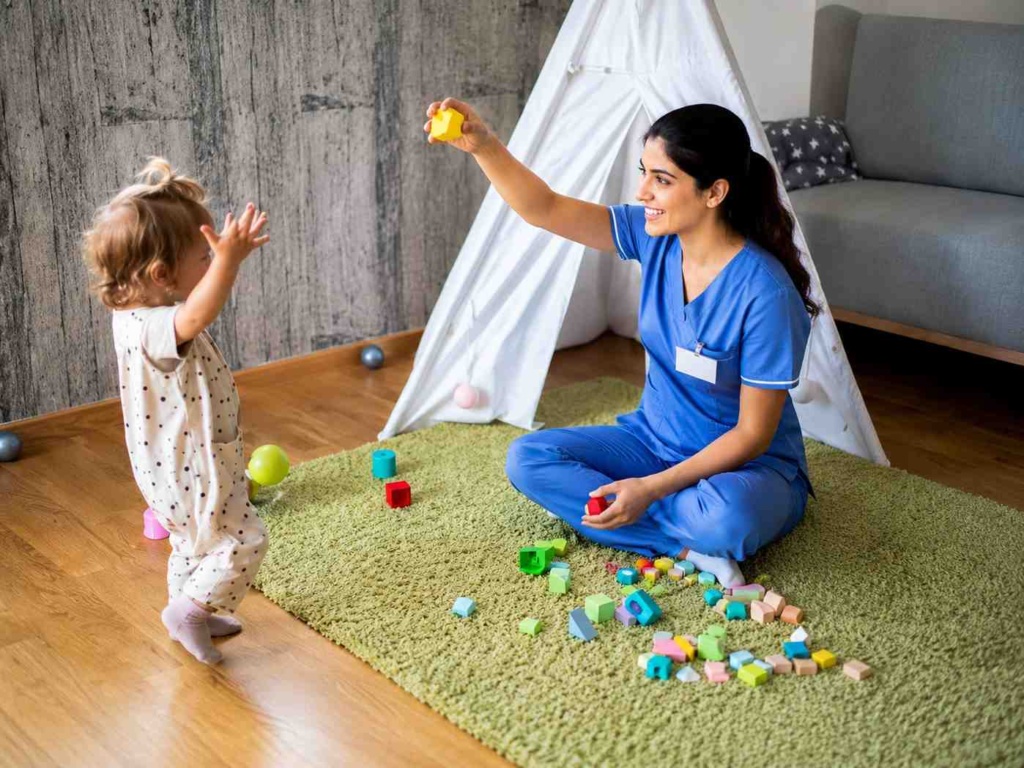
What You Can Do Right Now: 7 OT-Inspired Activities at Home
You don’t have to wait for a therapy appointment to start supporting your child. These playful, everyday activities can build the very skills that occupational therapy targets.
1. Playdough and Clay Play
Rolling, squeezing, and shaping playdough is a fantastic workout for the small muscles in the hands. Aim for 10–15 minutes daily. Let your child choose what to make-engagement matters!
2. Obstacle Courses Indoors
Use pillows, chairs, and blankets to create simple obstacle courses. Crawling, climbing, and balancing build proprioceptive and vestibular awareness (the body’s sense of position and movement).
3. Tearing and Cutting Paper
Tearing newspaper or tissue paper into small pieces, or cutting simple lines with child-safe scissors, builds fine motor control that directly supports handwriting readiness.
4. “Heavy Work” Activities
Ask your child to help carry groceries, push a laundry basket, or move cushions. This kind of deep pressure input can be calming and organizing for the sensory system.
5. Puzzles and Building Blocks
Age-appropriate puzzles challenge visual-motor integration. Building with blocks supports spatial reasoning and hand-eye coordination simultaneously.
6. Finger Painting and Sensory Bins
Fill a bin with dry rice, sand, or lentils and hide small objects inside. Searching through different textures is excellent for children who are either avoidant of or seeking sensory input.
7. Dress-Up Play
Practicing buttons, zippers, velcro, and snap closures during imaginative play makes self-care skill-building feel like fun, not a task.
Remember: The goal is joyful engagement, not perfection. Follow your child’s lead and keep activities positive.
When to Seek Professional Help: What to Expect at a Child Development Center in Jaipur
Home activities are wonderful support tools – but they are not a substitute for professional evaluation when your child’s developmental needs go beyond what typical play can address.
It’s time to reach out to a specialist if:
- Your child’s challenges are significantly impacting daily life at home or school
- Preschool or school teachers have raised consistent concerns
- Your child is showing distress, frustration, or withdrawal because of their difficulties
- You’ve noticed delays across multiple developmental areas
- Your child has an existing diagnosis (such as autism spectrum disorder, ADHD, cerebral palsy, or a genetic condition) that affects daily functioning
What Happens at an Evaluation?
When you visit an Occupational Therapy Centre, here’s what the process typically looks like:
- Initial Consultation – A therapist speaks with you about your concerns, your child’s history, and what daily life looks like at home and school.
- Standardized Assessments – Your child participates in play-based activities and structured tasks that help the therapist understand their sensory, motor, and cognitive profile.
- Observation – The therapist observes how your child interacts, moves, responds to sensory input, and approaches challenges.
- Personalized Report & Plan – You receive a clear, jargon-free explanation of findings and a tailored therapy plan with realistic, goal-oriented steps.
There is no judgment here – only a team of professionals who genuinely want to understand your child and help them flourish.
Why Families in Jaipur Choose Paramount Child Development Center
At Paramount Child Development Center, we understand that every child is unique – and every family comes to us carrying a mixture of hope, worry, and love.
Our multidisciplinary team brings together pediatric occupational therapists, speech-language pathologists, special educators, and child psychologists under one roof. This integrated model means your child’s care is coordinated, consistent, and truly comprehensive.
We offer:
- Pediatric Occupational Therapy in Jaipur tailored to your child’s sensory, motor, and daily living needs
- Special education services in Jaipur for children who need individualized academic support
- Autism therapy delivered through evidence-based, child-centred approaches
- Speech therapy in Jaipur for communication and language development
- Parent coaching and training, so the progress made in therapy continues at home
We believe the best outcomes happen when parents and therapists work as partners. You are not a bystander in your child’s journey – you are the most important part of it.
Take the First Step – We’re Here for You
You’ve already done something brave today: you sought information. That instinct to learn and advocate for your child is exactly what they need.
If any part of this guide feels familiar – if you recognized your child in these pages – we warmly invite you to reach out to Paramount Child Development Center for a free initial consultation or developmental milestone screening.
There’s no pressure, no labels, and no judgment. Just a caring team of specialists who are genuinely here to help your child – and your family – move forward with confidence.
Call us or WhatsApp: +91- 6376 345 510
Visit us online: paramountcdcjaipur.com
Find us in Jaipur: 1st Floor , 10 Kailashpuri , Main Tonk Road , Opposite BMW Showroom , Durgapura , Jaipur , Rajasthan 302015
Find us in Sikar: 2nd Floor, Savigo Tower (Above Tanishq & LG Showroom) Opposite Police Line, Silver Jubilee Road, Sikar, Rajasthan 332001
Because every child deserves the chance to reach their full potential – and every parent deserves a trusted partner on that journey.
Paramount Child Development Center is a leading child development center in Jaipur offering pediatric occupational therapy, speech therapy, autism therapy, and special education services. Our team of experienced specialists is committed to evidence-based, family-centered care for children of all abilities.