
By the Paramount CDC therapy team · Clinically reviewed by Dr. Ojaswita Sharma, BOT, MOT · 16 October 2026
Short answer: Sensory processing difficulties mean a child’s brain over-reacts or under-reacts to everyday sensations such as sound, touch, movement, taste and light. A child may cover their ears at the pressure cooker whistle, refuse haircuts, or spin and crash into furniture all day. These difficulties are common in children with autism, ADHD and developmental delay, but they also occur on their own. An occupational therapist can assess the pattern and use sensory integration therapy and daily “sensory diet” activities to help your child cope.
Key takeaways
- There are two main patterns: over-responsive children avoid sensations, and under-responsive or sensory-seeking children don’t notice them or crave more. Many children have a mix.
- Sensory reactions are not bad behaviour. They are the child’s nervous system responding the only way it can.
- Sensory difficulties are common alongside autism, ADHD and developmental delay, but don’t on their own mean a child is autistic.
- The American Academy of Pediatrics advises that sensory-based occupational therapy be used as one part of a wider treatment plan, with clear goals that parents can see progress on.
- Simple daily activities at home, called a sensory diet, make a big difference between therapy sessions.
Signs of sensory processing difficulties
Look at the pattern over weeks, not one bad day. Most children dislike some sensations; sensory difficulties are when reactions are strong enough to get in the way of daily life.
| Sense | Over-responsive (avoids) | Under-responsive or seeking (craves) |
|---|---|---|
| Sound | Covers ears at the pressure cooker, mixer, hand dryer or a wedding band; upset in noisy markets | Doesn’t respond to their name; makes loud noises; likes the TV very loud |
| Touch | Hates haircuts, nail cutting, hair oiling, clothing labels or messy hands | Touches everything and everyone; doesn’t notice a dirty face; high pain tolerance |
| Movement | Fears swings, slides, escalators or having feet off the ground | Constantly spins, jumps, climbs and crashes; never seems dizzy |
| Taste and mouth | Gags on textures; eats only a few soft or dry foods | Chews shirts, pencils and toys; stuffs the mouth with food |
| Sight | Upset by bright lights or busy, crowded places | Stares at lights, fans or spinning objects |
| Body awareness | Avoids rough play | Heavy-handed, breaks toys, falls often, leans on people |
Why sensory difficulties matter
A child who is overwhelmed by noise cannot concentrate in a classroom. A child who needs constant movement struggles to sit for meals or homework. Sensory difficulties often sit behind problems with sleep, eating, dressing, school behaviour and meltdowns. When the sensory side is understood, many “behaviour problems” start to make sense.
Sensory difficulties are frequently seen alongside autism and ADHD. Our article on sensory integration therapy for ADHD and autism explains how the picture differs between the two.
How sensory integration therapy works
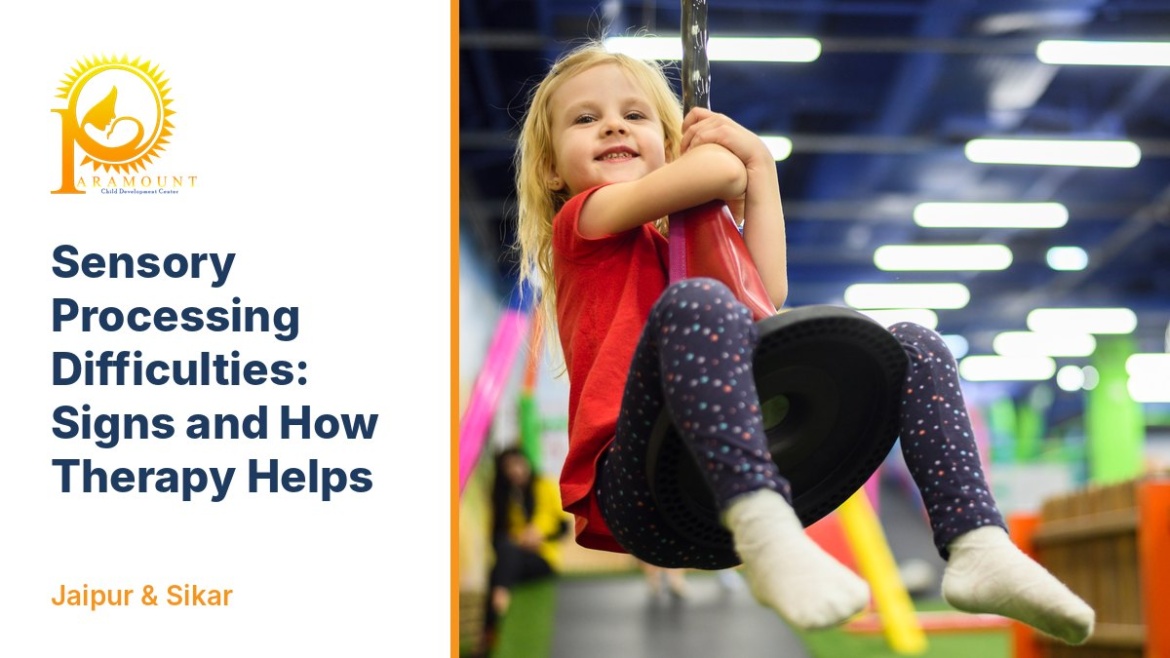
Sensory integration therapy is delivered by an occupational therapist in a therapy room equipped with swings, a trampoline, a ball pit, climbing equipment and materials with different textures. To your child it feels like play. The therapist sets up “just right” challenges that help the nervous system process sensations in a more organised way, for example gradually building tolerance to touch, or giving a sensory-seeking child the strong movement input they need so they can then settle and focus.
Therapy also includes a sensory diet for home and school, and changes to the environment, such as ear defenders in noisy places or a movement break before homework.
The research on sensory integration therapy is still developing. The American Academy of Pediatrics recommends that it be used as one part of a comprehensive plan, with specific goals. At Paramount, we agree goals with you at the start, such as “tolerates a haircut” or “sits through a 15-minute meal”, and review progress against them.
Sensory diet ideas you can try at home
These are general ideas. Your child’s occupational therapist will tailor them, especially for children who are very over-responsive.
- Heavy work: carrying a shopping bag, pushing a laundry basket, helping move cushions, wall push-ups
- Movement: jumping on a mattress or trampoline, swinging at the park, animal walks (bear walk, frog jumps)
- Hands: kneading atta dough, playing in a tub of rice or dal, play dough, squeezing a stress ball
- Mouth: crunchy or chewy snacks, blowing bubbles, drinking through a straw
- Calming: a quiet corner with cushions, a heavy blanket over the lap, dim lights, soft music or headphones
Movement and heavy-work activities just before homework or a meal often help sensory-seeking children settle.
When to get a sensory assessment
- sensory reactions are causing daily meltdowns or family stress
- your child refuses haircuts, nail cutting, bathing or clothing to the point of distress
- your child eats only a very small range of foods because of texture
- your child is constantly moving, crashing or hurting themselves
- a teacher reports your child cannot cope with noise, sit still, or join group activities
- your child also has, or may have, autism, ADHD or a developmental delay
Getting help in Jaipur and Sikar
Paramount Child Development Centre offers sensory integration therapy for children at both of its centres, with the same assessment approach and the same team model: our Durgapura centre in Jaipur, and our Silver Jubilee Road centre in Sikar, which also serves families from Jhunjhunu, Neem Ka Thana and the wider Shekhawati region. Choose the centre closer to home; regular therapy is much easier to keep up when the journey is short.
Read more about sensory integration therapy in Jaipur and sensory integration therapy in Sikar. Not sure which therapy your child needs? Start with a child development assessment, available at both centres.
Related reading
Frequently asked questions
Is sensory processing disorder a medical diagnosis?
“Sensory processing disorder” is widely used by therapists but is not a separate diagnosis in the main diagnostic manuals. Sensory over- and under-reactivity is, however, recognised as part of autism. Whatever the label, an occupational therapist can assess your child’s sensory profile and how it affects daily life.
Do sensory issues mean my child is autistic?
No. Many children without autism have sensory difficulties, including children with ADHD, developmental delay or anxiety, and children with no other diagnosis. If you also see social or communication differences, ask for a developmental assessment.
Will my child grow out of sensory issues?
Many children cope much better as they grow, especially with therapy and the right support at home and school. Some sensory preferences last for life, and the aim is for your child to manage them comfortably.
How long does sensory integration therapy take?
It depends on your child’s needs and goals. Progress is reviewed regularly against the goals agreed at the start, and the plan is adjusted as your child changes.
Can I do sensory activities at home without a therapist?
Yes. Simple heavy-work and movement activities are safe for most children. For a child who is very over-responsive or distressed, get guidance first, because the wrong activity at the wrong time can overwhelm them.
Where can my child get sensory integration therapy in Jaipur or Sikar?
Paramount Child Development Centre offers sensory integration therapy, delivered by occupational therapists, at its Durgapura centre in Jaipur and its Silver Jubilee Road centre in Sikar. Call or WhatsApp +91 6376 345 510.
Book a sensory assessment in Jaipur or Sikar
Jaipur: 1st Floor, 10 Tonk Road, opposite BMW Showroom, Kailash Puri Colony, Durgapura, Jaipur 302015. Monday to Saturday, 10:00 to 19:30.
Sikar: 2nd Floor, Savigo Tower (above Tanishq & LG Showroom), opposite Police Line, Silver Jubilee Road, Sikar 332001. Monday to Saturday; call for timings.
Book an assessmentCall or WhatsApp: +91 6376 345 510
This article is for general information and does not replace an individual assessment by a qualified professional. If you are worried about your child’s development, health or safety, please speak to a qualified professional or your paediatrician.