By the Paramount CDC therapy team · Clinically reviewed by Dr. Ojaswita Sharma, BOT, MOT · 14 October 2026
Short answer: Stammering (also called stuttering) is common in young children. Between 5 and 10 percent of children stammer for a period, usually starting between the ages of 2 and 6, and about 75 percent outgrow it. See a speech therapist if the stammering has lasted 3 to 6 months, if your child is straining or avoiding speaking, or if someone in the family stammers. Early therapy works well, and getting help does not make stammering worse.
Key takeaways
- According to the US National Institute on Deafness and Other Communication Disorders, 5 to 10 percent of children stammer at some point, mostly between ages 2 and 6, and about 75 percent recover.
- Get an assessment if the stammering has lasted 3 to 6 months, if your child strains or struggles to get words out, or if there is a family history of stammering.
- Stammering is not caused by parenting, fear or copying another person. Never tease, punish or ask your child to “say it properly”.
- Telling a child to “slow down” or “take a breath” rarely helps. Slowing your own speech does.
- For young children, speech therapy mostly works through the parents, with short daily practice at home.
What stammering sounds like
Every child trips over words sometimes, especially between ages 2 and 5, when vocabulary and sentences are growing very fast. Stammering is different. It usually shows up as one or more of these:
- Repeating sounds or syllables: “m-m-m-mummy”, “I w-w-want”
- Stretching sounds: “ssssssun”, “Mmmmmilk”
- Blocks: your child’s mouth is ready to say the word, but no sound comes out for a moment
- Struggle behaviours: blinking, tensing the face or neck, head jerks, foot tapping, or a rise in pitch while trying to get a word out
- Avoidance: switching to an easier word, saying “I forgot”, or not speaking at all
Normal speech bumps or stammering?
This table is a rough guide. If you are unsure, an assessment will settle it quickly.
| Usually typical speech development | More likely to need an assessment |
|---|---|
| Repeats whole words or phrases: “I want, I want the ball” | Repeats parts of words: “b-b-b-ball”, often more than twice |
| Relaxed; your child doesn’t seem to notice | Tension, facial strain, blinking or head movements while speaking |
| Comes and goes over a few weeks | Has continued for 3 to 6 months or more |
| Your child talks freely and happily | Your child avoids words, stops talking, or says “I can’t say it” |
| No one in the family stammers | A parent, sibling or close relative stammers or used to |
What causes stammering?
Stammering is linked to differences in how the brain plans and times the movements needed for speech. It often runs in families. Excitement, tiredness or being rushed can make it worse on a given day, but they don’t cause it.
Stammering is not caused by a fright, by strict parenting, by copying a relative who stammers, or by speaking two languages at home. Tongue-tie is also not a cause of stammering. Boys are more likely than girls to keep stammering as they grow older.
What helps at home
- Slow your own speech down and pause for a second before you answer. Children copy the pace around them.
- Give your full attention when your child talks. Look at them and wait calmly, without hurrying them.
- Don’t finish their words or sentences for them, however tempting.
- Avoid “slow down”, “take a breath” or “start again”. These add pressure, even when said kindly.
- Ask fewer rapid-fire questions. Comment on what your child is doing instead.
- Keep a calm daily talking time: five minutes of one-to-one play with no phones and no rush.
- Get the family on the same page. Grandparents, teachers and older siblings should follow the same approach, and no one should tease or imitate.
- Praise what your child says, not how they say it.
When to see a speech therapist
- the stammering has lasted 3 to 6 months or more
- your child shows tension, struggle, or blocks where no sound comes out
- your child is upset by it, avoids talking, or is being teased
- someone in the family stammers or used to
- your child also has other speech or language difficulties
- your child is school-age or a teenager and still stammers
Don’t wait to “see if they grow out of it” if any of these apply. An assessment is quick, therapy is easier when it starts early, and many families find the advice alone takes the pressure off at home.
How speech therapy helps
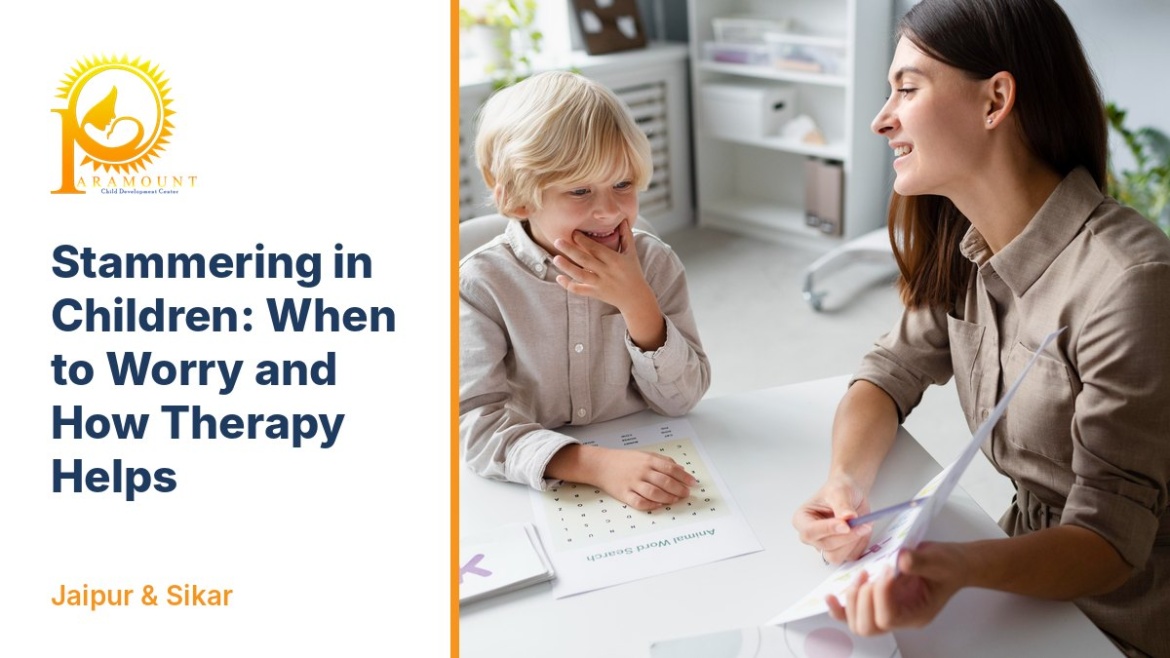
For children under about 6, therapy is usually parent-led. The speech therapist teaches you exactly what to do and say during short daily practice at home, and checks progress in sessions. The Lidcombe Program is one well-known example of this kind of approach. Changes to the speaking environment at home, such as slower family speech and fewer demands, are also part of the plan.
For older children and teenagers, therapy teaches techniques for speaking more smoothly, such as easy, relaxed starts to words and a slightly slower rate, and techniques for stammering more easily with less tension. It also works on confidence: answering in class, phone calls, viva and interview situations, and dealing with teasing.
How long therapy takes depends on your child’s age, how long they have stammered, and how much practice happens at home. Be cautious of anyone who promises a guaranteed “cure” in a fixed number of sessions.
Getting help in Jaipur and Sikar
Paramount Child Development Centre offers speech therapy for children at both of its centres, with the same assessment approach and the same team model: our Durgapura centre in Jaipur, and our Silver Jubilee Road centre in Sikar, which also serves families from Jhunjhunu, Neem Ka Thana and the wider Shekhawati region. Choose the centre closer to home; regular therapy is much easier to keep up when the journey is short.
Read more about speech therapy in Jaipur and speech therapy in Sikar. Not sure which therapy your child needs? Start with a child development assessment, available at both centres.
Related reading
Frequently asked questions
Will my child grow out of stammering?
About 75 percent of children who start stammering stop by themselves, but no one can tell in advance which children will. Stammering that has lasted more than 6 months, a family history of stammering, and being a boy all make it more likely to continue. That is why an assessment is worthwhile rather than waiting.
Can stammering be cured completely?
Many young children stop stammering, especially with early therapy. For older children and adults, the goal is usually smoother, more confident speech and less fear of speaking, rather than a promise that stammering will never happen again. Be cautious of guaranteed cures.
Does correcting my child make stammering worse?
Constant correction, such as “slow down” or “say it again properly”, adds pressure and can make a child more anxious about speaking. Waiting calmly, slowing your own speech and focusing on what your child is saying works better.
Is stammering linked to intelligence?
No. Stammering has nothing to do with how intelligent a child is. Many children who stammer do very well at school, especially when teachers understand how to support them in class.
Can speaking Hindi and English at home cause stammering?
There is no good evidence that learning two languages causes stammering. Keep using the languages your family naturally speaks. A speech therapist can advise you if your child stammers more in one language.
Where can my child get help for stammering in Jaipur or Sikar?
Paramount Child Development Centre offers speech therapy for children who stammer at its Durgapura centre in Jaipur and its Silver Jubilee Road centre in Sikar. Call or WhatsApp +91 6376 345 510 to book an assessment.
Book a stammering assessment in Jaipur or Sikar
Jaipur: 1st Floor, 10 Tonk Road, opposite BMW Showroom, Kailash Puri Colony, Durgapura, Jaipur 302015. Monday to Saturday, 10:00 to 19:30.
Sikar: 2nd Floor, Savigo Tower (above Tanishq & LG Showroom), opposite Police Line, Silver Jubilee Road, Sikar 332001. Monday to Saturday; call for timings.
Book an assessmentCall or WhatsApp: +91 6376 345 510
This article is for general information and does not replace an individual assessment by a qualified professional. If you are worried about your child’s development, health or safety, please speak to a qualified professional or your paediatrician.